Building certification entails a comprehensive and independent evaluation and approval procedure for construction projects. This process guarantees compliance with safety, health, amenity, and sustainability benchmarks across three essential levels.
- Local Council
- State Government
- Nationally under the National Construction Code
Builders engage a building certifier to carry out inspections and authorise work at various stages throughout the construction process. Following each approval, the building owner receives prompt notifications.
For detailed information, please refer to Form 16 – Inspection Certificate.
Key Insights on Inspections for Class 1a to Class 10 Buildings
Buildings are classified based on their intended usage and design features.
At A1 Certifier, we specialise in all building classifications, with a strong focus on Class 1a Buildings, which comprise residential properties.
Class 1a buildings are defined as individual dwellings primarily designated for residential living. This category encompasses standalone homes, duplexes, townhouses, villa units, and terrace houses.
Essential Inspections for Class 1a and Class 10 Buildings
- Footing – An inspection is conducted after the foundation material has been excavated and prior to pouring concrete for the footings or floor slab.
- Floor slab – If applicable, an inspection takes place after formwork and reinforcement are installed, but before the concrete is poured.
- Frame – A comprehensive inspection of the building frame is necessary (refer to section 44 of the Building Regulations 2021 for specifics).
- Final acceptance – This inspection evaluates all outstanding items, including certificates for termite protection, wet area membranes, glazing, smoke detectors, and energy efficiency.
During the final inspection of Class 1a buildings, we verify compliance in several crucial areas:
- Siteworks and drainage
- Termite management systems
- Damp and weatherproofing
- Fire safety measures
- Health and amenity considerations
- Safe movement and access provisions
- Construction of wet areas
- Glazing standards
- Sub-floor ventilation
- Energy efficiency compliance
- Water conservation strategies
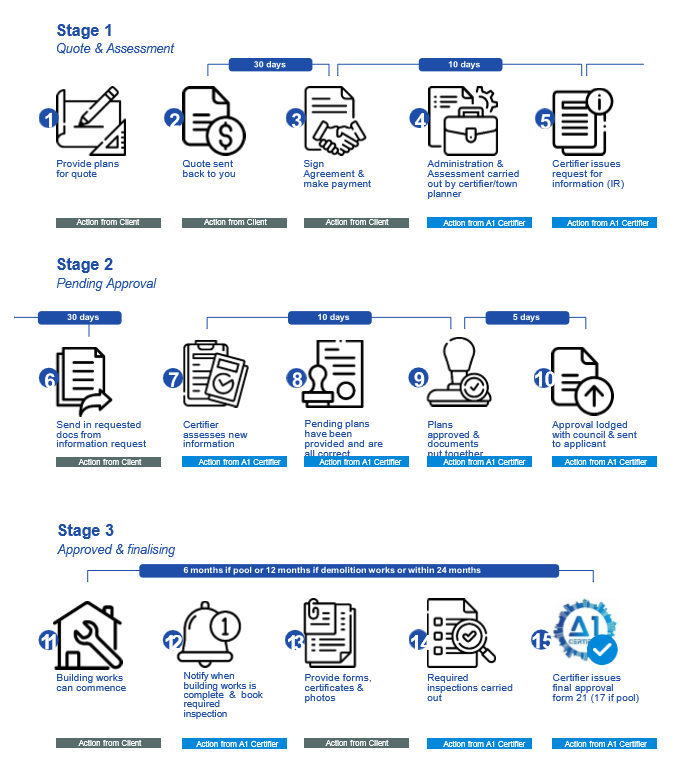
Discover Our Comprehensive Certification Process
What Common Misconceptions Exist About Building Certifiers?
Understanding the role of a building certifier is essential; we do not oversee construction projects, nor do we act as building inspectors.
Our main duty is to ensure that builders comply with the approved building plans and that all necessary inspections meet the standards established by local councils, the state government, and the National Construction Code.
A1 Certifier is dedicated to ensuring that the builders we partner with deliver construction that meets the highest quality standards.
We do not overlook subpar work; our approval is vital for all completed tasks, and our reputation and licensing depend on this commitment.
If any elements of the construction deviate from the approved plans, we offer guidance on necessary amendments to achieve full compliance.
We keep our clients informed about the progress of their construction approvals.
Contact A1 Certifier today to discuss your upcoming building projects.
We proudly serve clients across Queensland, from the Gold Coast to Ipswich and all the way to Mackay.
Original Article First Published At: How Does Building Certification Work?
The Article: Building Certification: Understanding the Process and Benefits first appeared on https://writebuff.com
The post Building Certification Process and Its Key Benefits Explained appeared first on Limits Of Strategy.
References:
Building Certification Process and Its Key Benefits Explained